Pages

Friday, April 1, 2016

The Fishermen's Widow

 The story of my great-grandmother, Hansine Marie Hermansen (1859-1942). This story was long-listed in the British Writing Competition Multi-Story, Flash Fiction in 2012.

Life of the Fishermen’s Widow          

            There are no ships in sight as I stand on the stony beach looking out at the living water. Not like my family, all gone a long time ago now. The wind teases my grey hair, what is left of it anyway. It used to be thick and wavy. Now I pull it back in a small bun and when strands of hair come undone and play with the wind, I don’t mind.
            Hats were never for me, I would rather wear a kerchief. My neighbor, Milly jokes about that. “I would like to see the person who can put a hat on Hansine,” she says. She’s a good neighbor, Milly. When the winter nights here in the north are dark and gloomy, she lets me come and stay with her. I hear people say I am afraid of the dark, but being worried and being afraid is not necessarily the same thing.
            “How do you manage?” Milly asks. “You have lost both your husbands and all three of your sons at sea.”
            They wonder why I always come down here to the beach on tempestuous days. I stand as close as I can without getting wet. The blustery weather is cold enough. Here I can be alone with my thoughts. Only the ocean moves towards the shore and the occasional seagull looks for fish in the waves. There’s never anyone here to respond to my voice, only new thoughts entering my wits, wondering and grinding.
            Questions about my family often emerge when Milly is around. “It will help talking about it,” she says and puts the kettle on. But I don’t speak about my children. They were given me, they were taken away. Words won’t change that.
            Sometimes I will mention funny things Berner said. He was the love of my youth, the one who chose me for life. Two and a half years was the time we were allotted. Enough time to learn to love, but not enough to be satisfied. I gave birth to our second child a few weeks after the sea claimed him.
            Then there was Karolius, who also chose me, a widow with two small children. I learned to love again, to live again.
            “Tell me about your grandchildren,” Milly continues. She has not given up on me. My thoughts go to my daughter, who married and settled in a town north of here. Photographers enjoyed capturing her beauty, but the Spanish flu grasped her life, along with her husband’s, leaving six children nine years and under. My grandbabies were divided among families far away from me. There’s not much I can tell Milly about them.
            What I would give to be able to do it over again, this life. I have spent enough time pondering on the outcome of the years past. When I was in the middle of things I did the best I could. Why is it that I think it would be different if I had a new chance at life? Both my husbands would still be fishermen, all my sons would follow in their fathers’ footsteps.
            I believe that when my turn on earth is over, I will look back thinking I spent too much time worrying. Though I can state this as a fact, my whole being is permeated with anxiety and concern.

            I wipe my hand across my wet cheeks, thinking it’s time to go back. The wind has picked up, a storm is approaching. As always, I will stay out of the lamp light when I return. On a night like this, I won’t engage in conversation.


Foto: Hansine Marie Hermansen

Tuesday, March 22, 2016

What would you do if you weren't afraid?

I have a fascination for the women who fought in various resistance groups during WWII. Fascination in the way that I admire them for their fearless courage, commitment to a cause they believed in, and total dedication in the struggle and fight for freedom.
I feel grateful for them, grateful to think that they risked having to leave their home and family, they risked their own life. They gave up jobs and personal safety. They lived a life in danger, always having to look over their shoulder, always being careful in everything they did.

As their husbands, sons and fathers were away at war, many women took on jobs they normally would not have had. They kept the work places going. They fed their families. Previous forbidden job opportunities opened up for women.

Some were drafted to non-combat jobs in the military. But there were many who worked underground. Some were spies, others worked with cryptography. But most often women helped house refugees and other members of the resistance groups and helped make and distribute illegal newpapers.

One of the most dangerous tasks women had during the war, was that of a courier. Even though the Germans did not suspect a woman as much as they would a man in this role, it was the most hazardous job to have. If they were caught, they had the sensitive material with them. There was no excuse, nor any way out.

Some were caught and sent to prison, experiencing torture and horrible treatment. Many ended up in concentration camps.

As a freelance magazine journalist, I recently finished an article about a Norwegian resistance woman, Henriette Bie Lorentzen. As I learned about her life and her bravery, I was filled with admiration and gratefulness. I spoke with her son and daughter, the latter who was actually born while Henriette was imprisoned.

I salute these women and thank them. Even if they survived the war, many
would have problems for the rest of their lives, both psychological with post-traumatic stress-syndrom and trying to forget with alchohol and pills.

Today, I read a meme that said, "What would you do it you weren't afraid?". It was from the Togethernessproject, a group that invites women to stand together, and be brave together.

It got me thinking. What would I do with my life if I had no fear of men, no fear of what others might say or think? What could I accomplish in my life if I did not worry, if I wasn't sceptical and filled with a lack of self-confidence. Would my life be different? Would I do things differently?

It's a thought I will pursue and ponder. Maybe I will be able to see that I can do more than I think now.

Today's water color is "Late Spring". Choose the darkness of the clouds or the light piercing through.


Tuesday, February 2, 2016

I apologize for wearing my PJs in public

So sorry.
Excuse me.

But hey, what should I apologize for?
Staying busy? Doing good things? Being creative?

But in my pyjamas?

There are days when the creative flows are like a spring flood. Like melting snow from the mountains that trickles downhill, adding more and more to it's stream, eventually turning into a billowy, raging force.

And excuse me, on these days I may forget to brush my hair and change out of my PJs.

The problem is when I forget to change my apparel before leaving the house.
One morning I drove the love of my life to the train station - in my PJs.
At the station I noticed I had a flat tire. I slowly eased the car to a nearby garage.

What to do? The garage had not opened yet. It was cold. I stood there wondering whether to walk home in my PJs or call a friend. Asking for help is not my strong suit. I do not excel at being on the receiving end.

I finally gave in and called Åse. She is wonderful and came to my rescue - with a smile.

Is there a moral to this story? Do we need one?
At least, for good advice, being an advocate for "being prepared", I would  suggest to myself to get dressed before driving off somewhere. At least, put on a coat over the PJs if it's chilly outside.

The wonderful actor, Sean Connery, once said that women who go shopping with curlers in their hair, should be arrested.
I would not go that far. He might think the same of me, had he seen me out and about in my pyjamas and unruly hair.

One of my favorite Shakespeare quotes is this.
"Being prepared for everything, is everything."
I like that, but still strive to get better at it.

Today's water color is "Before I go to sleep" - this fairy is out flying before bedtime, in her nightgown. Could have been me!


Tuesday, December 29, 2015

Everey Writer Shoud Have a Dog

Every writer should have a dog.

Why? What does that mean? Having a dog is a lot of work. It's like having an exrra child in the house. It means taking care of it,

But it's so much more than that. A dog takes care of you.

  • My dog gets me out of the chair.
  • He reminds me that I need to take a break. I have to take him for walks several times a day, in any kind of weather.
  • I feel loved and appreciated.
  • I feel safe.
  • He is a role model when it comes to napping.
  • He comforts me when I'm sad. He does. He knows, and comes to make me feel better.
  • He reminds me to play and never says no.
  • It's a  loving friend on days when I sit all alone with my words and story-in-the-making.
  • He is an excellent friend and will take the time to listen, if I need to read my story out loud.
  • He never criticizes my writing, but loves me for who I am.


I recently read an article called 8 Ways That Dogs Are Good For Your Mind, Body, And Soul
This article will back me up.
Having a dog is good for you. My life would be so much emptier without Hector the Wheaten Terrier, my good and loving friend.

Here are a few photos to show some of Hectors important jobs:


Protecting visiting munchkins.


Chrcking out the neighborhood every few hours.


Serious napping.

Wednesday, December 16, 2015

The Joy of Anticipation

Christmas time brings me more joy than I can explain in words. It's something about the anticipation of things to come, the happiness of preparing surprises, and the joy of opening the heart and home to family and friends. It's as if I travel with the magi, following the star, excited to meet the Savior of mankind.
Wonder of wonder. Miracles of miracles.
Just believe.


Friday, December 4, 2015

Seven kind of Christmas treats

Christmas traditions.

It's December and time to bake.
According to old Norwegian customs and traditions, a household should bake no less than 7 different kinds of Christmas cookies.
Christmas was special in olden days and nothing was spared. The best ingredients and TIME should be spent preparing for the holidays.
Every home prepared in their own way, the country farms would bake their own, but there were also professional baking folk, women went from place to place, offering their experise, The baked for those who could afford to pay. 7 different kinds. Which baked goods varied.

I asked my mother-in-law about her Christmas baking. What did she do with seven children and a busy household?

"I baked 13 or 14 different kinds," was her answer.
I believe it. She is amazing, always doing her best to make traditions a special treat for her family.
I asked her which kinds she baked. She started on her list - goro, krumkake, fattigmann . . .

By the time she had listed all the baked goods she made for her family for Christmas, I had counted 15 different kinds.

Today my mother-in-law is 90 years old. Still busy. Still making us feel welcome at Christmas time or any time of the year.

To many Norwegians, baking 7 different kinds of treats, is a must before Christmas Eve arrives. Homemade goods taste better, and are more special to serve, should a visitor or two drop by the house. Besides, when you do your own baking,
the whole house is filled with the smell of Christmas.

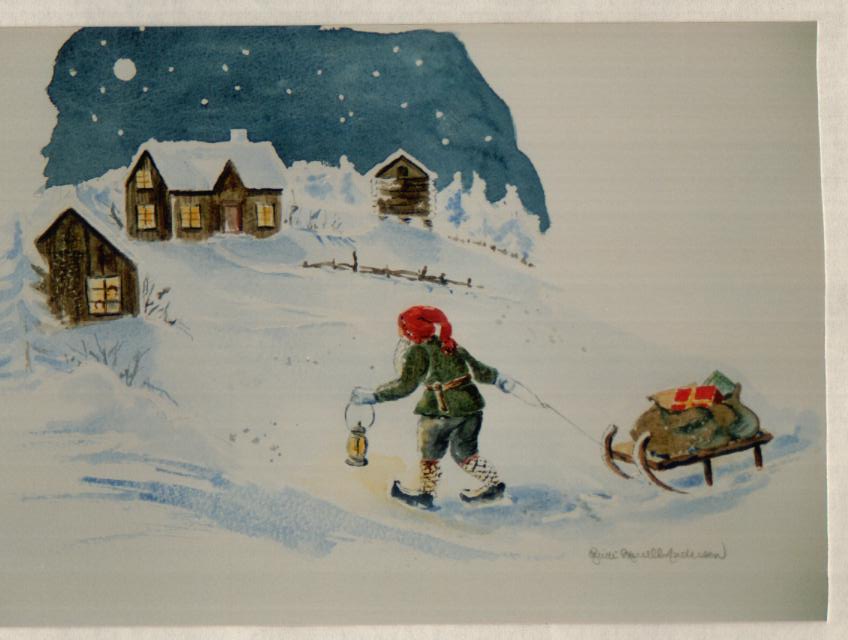
Today's water color is a traditional Norwegian "nisse", bringing presents to the people in a small farm.


Source: Nasjonalbiblioteket


Thursday, June 18, 2015

Becoming partly-minimalist

Joshua Becker is known for his pursuit of becoming a minimalist. I love to read his blog entries, full of sound, down to earth advice on how to enjoy more by having less.
It's a fact in my life, that clutter and messes make me tired. Carrying things from room to room instead of getting rid of some things, is something I have done forever. True, our family is large. True, we have treasures from a long life (at least treasures to us), and also things from our parents that we don't have the heart to get rid of . . . not yet, anyway.
But still, there are many things we don't need. A cardboard box that has not been opened in 10 years - do we really need it? What's in it anyway? I forget.
And so many extra this and thats, that fill up closet and cupboard space, just in case we need it.
I am a firm believer in being prepared and having a storage of food and important necessities, but this is not what I am talking about. To be quite honest - I have things in my house I don't need! 
Joshua Becker has come much further down the road to decluttering a life than I have. And I will probably never be as perfect about it as he is. Maybe deep inside I don't want to, or don't feel that a barren house is me. But I want to clean out unwanted and unneeded things in my house and life - a little by little. I know how good I feel every time I tidy up and throw some things out or give away something to charity.
Here is what Joshua Becker says about the idea of becoming minimalist:
After a conversation with my neighbor on Memorial Day 2008, we decided to become minimalist and intentionally live with fewer possessions. We cleared the clutter from our home and lives.
As a result, we found a better way to live centered on more important pursuits. It has been a journey of discovering the abundant life is actually found in owning less. And it still ranks as one the best decisions we’ve ever made.
But Joshua Becker has taken "becoming minimalist" further. Things and possessions are not what gives us value, something entirely different gives our lives fulfillment and value. Now, this I can truly vouch for and live with.
Read this entry from his blog:

35 Gifts Your Children Will Never Forget


You give but little when you give of your possessions. It is when you give of yourself that you truly give.” —Kahlil Gibran
I have countless holiday memories. Most of them center around faith, family, and traditions.
Very few childhood memories actually include the gifts I received. I distinctly remember the year that I got a blue dirt bike, the evening my brother and I received a Nintendo, and opening socks every year from my grandparents. But other than that, my gift-receiving memories are pretty sparse. Which got me thinking… what type of gifts can we give to our children that they will never forget? What gifts will truly impact their lives and change them forever?
To that end, here is an alphabetical list.
35 Gifts Your Children Will Never Forget:
1. Affirmation. Sometimes one simple word of affirmation can change an entire life. So make sure your children know how much you appreciate them. And then, remind them every chance you get.
2. Art. With the advent of the Internet, everyone who wants to create… can. The world just needs more people who want to…
3. Challenge. Encourage your child to dream big dreams. In turn, they will accomplish more than they thought possible… and probably even more than you thought possible.
4. Compassion/Justice. Life isn’t fair. It never will be – there are just too many variables. But when a wrong has been committed or a playing field can be leveled, I want my child to be active in helping to level it.
5. Contentment. The need for more is contagious. Therefore, one of the greatest gifts you can give your children is an appreciation for being content with what they have… but not with who they are.
6. Curiosity. Teach your children to ask questions about who, what, where, how, why, and why not. “Stop asking so many questions” are words that should never leave a parents’ mouth.
7. Determination. One of the greatest determining factors in one’s success is the size of their will. How can you help grow your child’s today?
8. Discipline. Children need to learn everything from the ground-up including appropriate behaviors, how to get along with others, how to get results, and how to achieve their dreams. Discipline should not be avoided or withheld. Instead, it should be consistent and positive.
9. Encouragement. Words are powerful. They can create or they can destroy. The simple words that you choose to speak today can offer encouragement and positive thoughts to another child. Or your words can send them further into despair. So choose them carefully.
10. Faithfulness to your Spouse. Faithfulness in marriage includes more than just our bodies. It also includes our eyes, mind, heart, and soul. Guard your sexuality daily and devote it entirely to your spouse. Your children will absolutely take notice.
11. Finding Beauty. Help your children find beauty in everything they see… and in everyone they meet.
12. Generosity. Teach your children to be generous with your stuff so that they will become generous with theirs.
13. Honesty/Integrity. Children who learn the value and importance ofhonesty at a young age have a far greater opportunity to become honest adults. And honest adults who deal truthfully with others tend to feel better about themselves, enjoy their lives more, and sleep better at night.
14. Hope. Hope is knowing and believing that things will get better and improve. It creates strength, endurance, and resolve. And in the desperately difficult times of life, it calls us to press onward.
15. Hugs and Kisses. I once heard the story of a man who told his 7-year old son that he had grown too old for kisses. I tear up every time I think of it. Know that your children are never too old to receive physical affirmation of your love for them.
16. Imagination. If we’ve learned anything over the past 20 years, it’s that life is changing faster and faster with every passing day. The world tomorrow looks nothing like the world today. And the people with imagination are the ones not just living it, they are creating it.
17. Intentionality. I believe strongly in intentional living and intentional parenting. Slow down, consider who you are, where you are going, and how to get there. And do the same for each of your children.
18. Your Lap. It’s the best place in the entire world for a book, story, or conversation. And it’s been right in front of you the whole time.
19. Lifelong Learning. A passion for learning is different from just studying to earn a grade or please teachers. It begins in the home. So read, ask questions, analyze, and expose. In other words, learn to love learning yourself.
20. Love. …but the greatest of these is love.
21. Meals Together. Meals provide unparalleled opportunity for relationship, the likes of which can not be found anywhere else. So much so, that a family that does not eat together does not grow together.
22. Nature. Children who learn to appreciate the world around them take care of the world around them. As a parent, I am frequently asking my kids to keep their rooms inside the house neat, clean, and orderly. Shouldn’t we also be teaching them to keep their world outside neat, clean, and orderly?
23. Opportunity. Kids need opportunities to experience new things so they can find out what they enjoy and what they are good at. And contrary to popular belief, this doesn’t have to require much money.
24. Optimism. Pessimists don’t change the world. Optimists do.
25. Peace. On a worldwide scale, you may think this is out of our hands. But in relation to the people around you, this is completely within your hands… and that’s a darn good place to start.
26. Pride. Celebrate the little things in life. After all, it is the little accomplishments in life that become the big accomplishments.
27. Room to Make mistakes. Kids are kids. That’s what makes them so much fun… and so desperately in need of your patience. Give them room to experiment, explore, and make mistakes.
28. Self-Esteem. People who learn to value themselves are more likely to have self-confidence, self-esteem, and self-worth. As a result, they are more likely to become adults who respect their values and stick to them… even when no one else is.
29. Sense of Humor. Laugh with your children everyday… for your sake and theirs.
30. Spirituality. Faith elevates our view of the universe, our world, and our lives. We would be wise to instill into our kids that they are more than just flesh and blood taking up space. They are also made of mind, heart, soul, and will. And decisions in their life should be based on more than just what everyone else with flesh and blood is doing.
31. Stability. A stable home becomes the foundation on which children build the rest of their lives. They need to know their place in the family, who they can trust, and who is going to be there for them. Don’t keep changing those things.
32. Time. The gift of time is the one gift you can never get back or take back. So think carefully about who (or what) is getting yours.
33. Undivided Attention. Maybe this imagery will be helpful: Disconnect to Connect.
34. Uniqueness. What makes us different is what makes us special.Uniqueness should not be hidden. It should be proudly displayed for all the world to see, appreciate, and enjoy.
35. A Welcoming Home. To know that you can always come home is among the sweetest and most life-giving assurances in all the world. Is your home breathing life into your child?
Of course, none of these gifts are on sale at your local department store. But, I think that’s the point.

Today's water color is called "On the road home" painted in 2004.